

Product Overview
EdgeNext CDN Introduction
CDN (Content Delivery Network) is an intelligent virtual network built on top of the existing Internet. Relying on edge servers deployed in various regions, it enables end-users of the Internet to obtain the required content nearby through functional modules such as load balancing, content distribution, and scheduling on the central platform.
With a globally deployed cluster of servers equipped with exclusive system programs, CDN can distribute origin server content to all edge nodes, enabling users to access resources nearby. CDN services can reduce content access latency for users, improve website response speed and service availability, and solve industry pain points such as insufficient network bandwidth, concentrated access traffic, and uneven geographical distribution of nodes.
EdgeNext CDN acceleration product relies on a global edge cloud architecture, with over 1,500 self-built edge nodes worldwide. It distributes origin server content to acceleration nodes close to users, allowing users to obtain resources nearby, alleviating network congestion, effectively improving access success rate and response speed, and optimizing end-user experience.
EdgeNext CDN Architecture
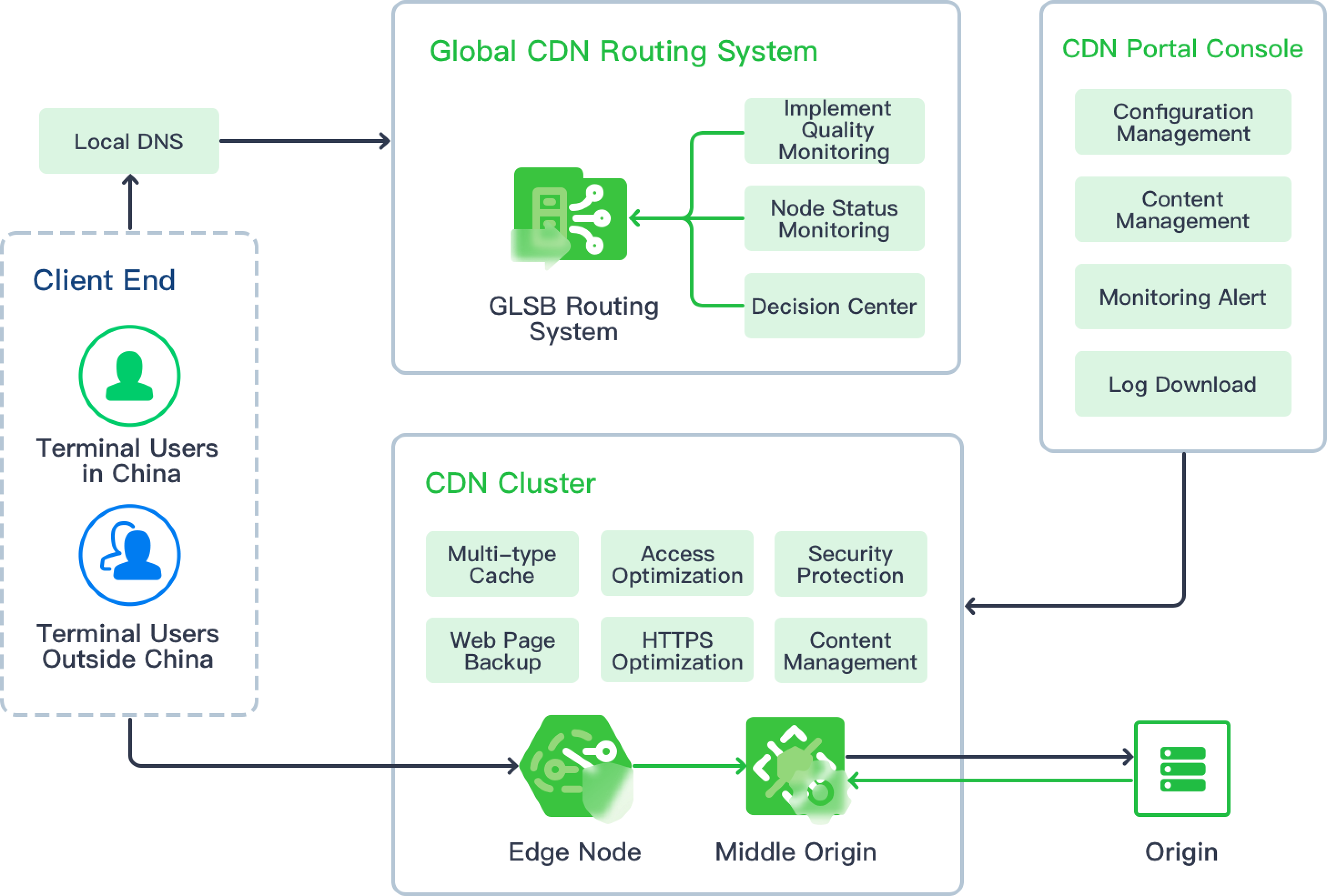
The core capabilities of EdgeNext CDN consist of seven modules: Intelligent Scheduling, Intelligent Caching, Origin Server Protection, Transmission Optimization, Request Management, Content Management, and Operational Visualization.
● Transmission Optimization
Transmission optimization covers technical measures including transmission protocol optimization, weak-network optimization, and intelligent compression, combined with solutions such as connection multiplexing, page redundancy optimization, and timeout retransmission to comprehensively improve data transmission efficiency.
● Intelligent Scheduling
The EdgeNext Intelligent Scheduling System is designed for precision and speed. Built on the new DOLFIN architecture, it returns the optimal node address based on user geographic location and carrier network information, ensuring users always access content via the best available network path.
● Origin Server Protection
Through multi-origin load balancing strategies such as primary/backup origins, round-robin origin pull, and weighted origin pull, combined with scheduling solutions including file prewarming, traffic control, offline mode, and zero-latency switchover, it significantly reduces origin pull traffic while ensuring stable service availability and lowering enterprise origin bandwidth costs.
How EdgeNext CDN Works
Assume the business origin domain is www.test.com. After the domain is onboarded to CDN acceleration, when a user sends an HTTP request, the system first obtains the optimal node IP via DNS resolution and then requests resources from that IP. The complete workflow is as follows:
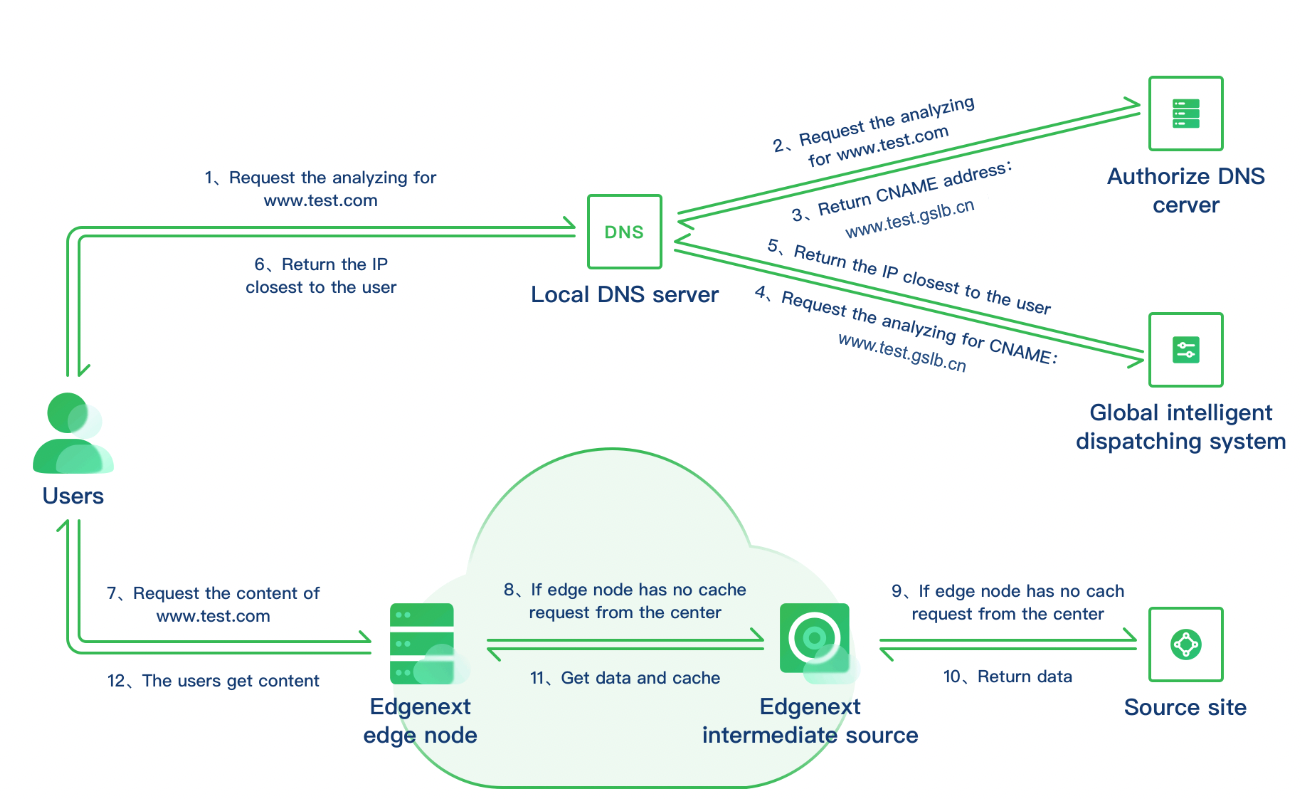
- A user requests a resource (e.g., test.mp4) under
www.test.comvia a website or APP. The client first sends a domain name resolution request to the local DNS. - The local DNS checks its cache. If an IP record for
www.test.comalready exists, it returns the IP directly to the end user; if no cache is found, it sends a resolution query to the domain's authoritative DNS. - The authoritative DNS resolves
www.test.com, recognizes that the domain is bound to a CNAME:www.test.com.glsb.cn, and returns the CNAME address to the local DNS. - The local DNS initiates a resolution request for
www.test.com.glsb.cn, which is forwarded to the EdgeNext CDN Global Intelligent Scheduling System. - The CDN Intelligent Scheduling System performs intelligent domain resolution and returns to the local DNS the IP address of the CDN edge node that is geographically closest to the user and delivers the best access speed.
- The end-user obtains the IP address of the optimal CDN node.
- After receiving the node IP, the user-side website/APP sends a resource access request to the CDN edge node.
- If the target resource is already cached on the edge node, the node returns the data directly to the user (Step 12); if not, it pulls the resource from the EdgeNext mid-tier origin.
- If the mid-tier origin server already has the corresponding resource cached, it returns the resource directly to the edge node (Step 11); if not, it sends an origin pull request to the customer's origin server.
- The origin server returns the resource data to the EdgeNext mid-tier origin.
- The EdgeNext mid-tier origin receives and caches the resource locally, and simultaneously delivers the data to the edge node.
- The edge node receives and caches the resource locally, and returns the content to the end user.
Product Advantages
Rich and Extensible Features
Built with comprehensive access control, origin pull control, and cache management capabilities, the overall system adopts a loosely coupled, componentized architecture that enables rapid delivery of various customized business requirements.
(1) Cache Management:
Supports global cache purge for scenarios such as cache expiration, with the fastest purge achievable at second-level latency;
Supports prefetching resources to CDN nodes in advance for promotional campaigns and hot events, further improving page response speed;
Allows enterprises to customize cache rules for specified resources.
(2) Access Control:
Supports Referer hotlink protection to identify and filter access sources and enforce access source restrictions;
Supports IP blacklist/whitelist configuration to block or allow access to accelerated domains from corresponding IPs;
Supports timestamp-based hotlink protection to block illegal access via expired URLs;
Custom access control rules can be configured on demand.
(3) Origin Pull Management:
Supports Range-based segmented origin pull, effectively reducing origin pull and distribution time for large files, improving origin pull efficiency and lowering origin pull bandwidth consumption;
Supports multi-origin load balancing strategies including primary/backup origins, round-robin origin pull, and weighted origin pull to reduce origin server load and improve service availability;
Supports HTTPS origin pull for full-link HTTPS secure acceleration.
Abundant Infrastructure Resources
Resources cover over 290 cities and 170+ carriers across six continents worldwide, with more than 1,500 self-built distributed edge nodes. User requests are precisely scheduled to nearby high-quality edge nodes, comprehensively optimizing access experience for global users.
Real-time Intelligent Scheduling
Real-time detection of link quality across all network nodes, combined with a self-evolving high-precision IP database and global intelligent scheduling capabilities, dynamically updates scheduling strategies to continuously ensure high-quality link access.
High Service Stability
Backed by massive bandwidth reserves, it easily handles sudden traffic dozens of times higher than daily business volume; combined with technologies such as transmission protocol optimization, cache prefetching, multi-level caching, and offline mode, it ensures stable end-to-end service operation.
Need help? Contact our support team at support@edgenext.com.
Back to documentation home