CDNs, or Content Delivery Networks, play a critical role in streaming media within China, overcoming unique challenges such as high traffic volumes and the Great Firewall's content restrictions. They achieve this by distributing content across multiple servers located within China, thus enhancing the speed and reliability of media delivery. CDNs also offer solutions for regulatory compliance, including data localization requirements, ensuring that streaming services operate smoothly and within the legal framework. By leveraging local CDN nodes, media companies can provide Chinese audiences with a seamless streaming experience, which is vital for success in one of the world's largest digital markets.
I. Introduction
II. The Streaming Media Landscape in China
III. Understanding China CDNs
IV. Challenges in Streaming Media within China
V. The Role of China CDNs in Addressing These Challenges
VI. China CDN Deployment Strategies for Optimal Streaming
VII. Future of CDNs in China's Streaming Media
VIII. Conclusion
I. Introduction
In recent years, the popularity of streaming media has soared in China, with an increasing number of users turning to online platforms for entertainment. However, this rise in demand has also brought about significant challenges for
content delivery networks (CDNs) that are responsible for ensuring smooth and efficient streaming services. In this document, we will delve into the crucial role of CDNs in enhancing streaming media within China, the challenges they face, and potential solutions to overcome these obstacles. So, this document aims to provide insight into the importance of CDNs in the rapidly evolving landscape of streaming media within China.
II. The Streaming Media Landscape in China
China's digital market is the largest in the world, with a massive population of internet users. This has led to a significant increase in streaming media consumption, with over 70% of Chinese internet users engaging in online video content. With the rise of popular platforms such as iQiyi, TicTok, and Youku, China's streaming media industry has become highly competitive, resulting in a growing demand for high-quality streaming services.
However, delivering content to a large and diverse audience presents numerous challenges. China's vast geographic size and varying internet infrastructure can lead to uneven distribution of streaming traffic, causing delays and disruptions in service delivery. Furthermore, strict censorship regulations imposed by the Chinese government also add to the complexity of content delivery within the country.
III. Understanding CDNs
CDNs are servers strategically located worldwide to deliver content from origin servers to end-users, providing faster and more efficient delivery. They work by storing cached versions of website resources on these servers closer to the user's location, reducing latency and increasing speed. In media streaming, CDNs simultaneously deliver large amounts of data, such as videos, to many users.
In China's streaming media landscape, CDNs are essential in overcoming the abovementioned challenges. By utilizing their network of servers in China, CDNs can improve content delivery speed and reliability for Chinese users. CDNs also have advanced technologies that can help bypass censorship restrictions imposed by the government, ensuring uninterrupted access to content.
IV. Challenges in Streaming Media within China
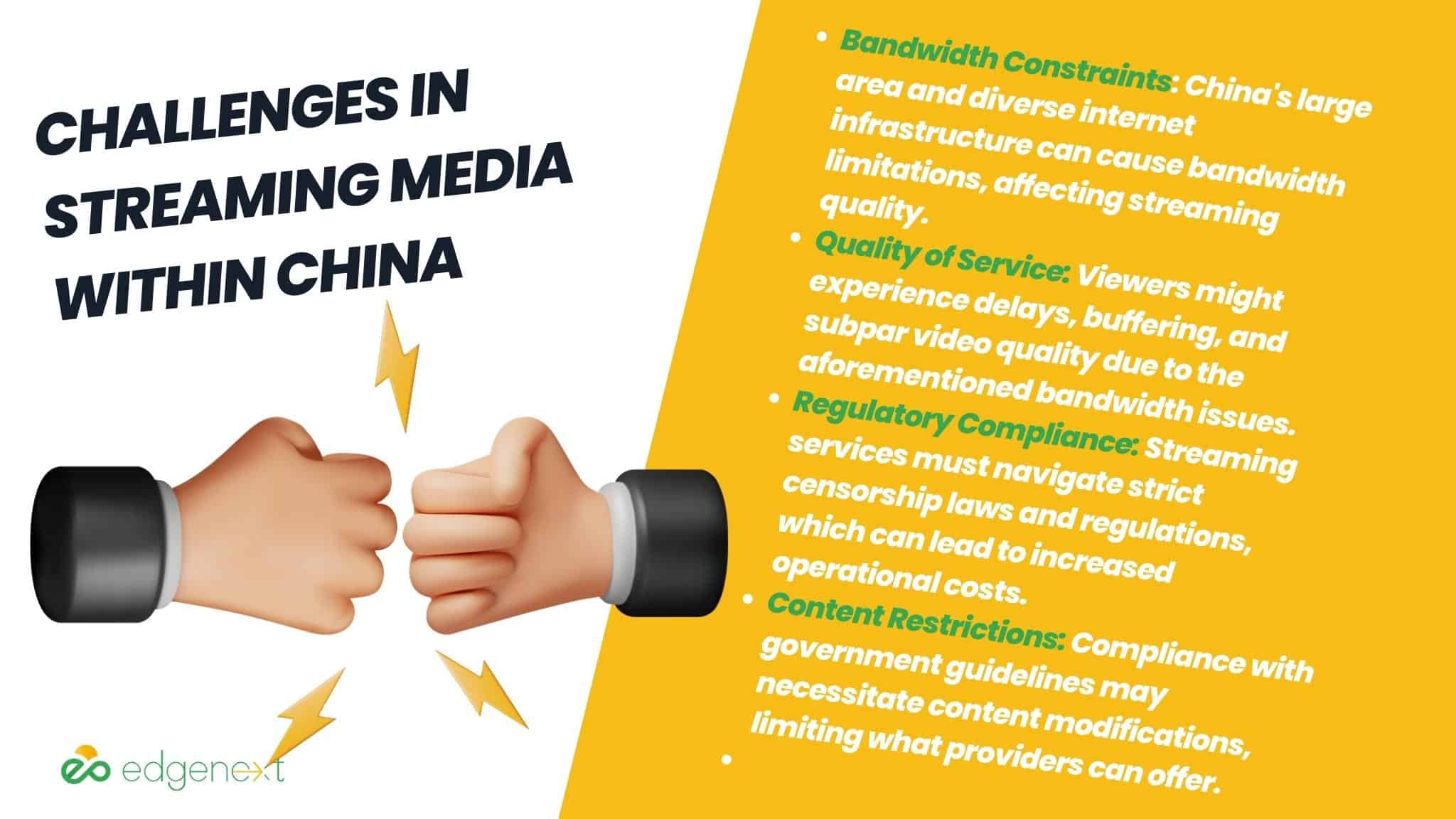
As mentioned, China's vast geographical size and varying internet infrastructure present significant bandwidth issues for streaming media content providers. This can result in delays, interruptions, and poor video quality for viewers. Strict regulatory compliance and censorship laws pose additional challenges, as they require content providers to tailor their services to meet government guidelines, resulting in added costs and potential limitations on content.
These challenges can negatively impact both the content providers and viewers. Content providers may experience higher costs and slower delivery times, while viewers may face limited access to certain content or poor streaming quality. This could ultimately lead to dissatisfied customers, hindering the growth and success of streaming media in China.
V. The Role of CDNs in Addressing These Challenges
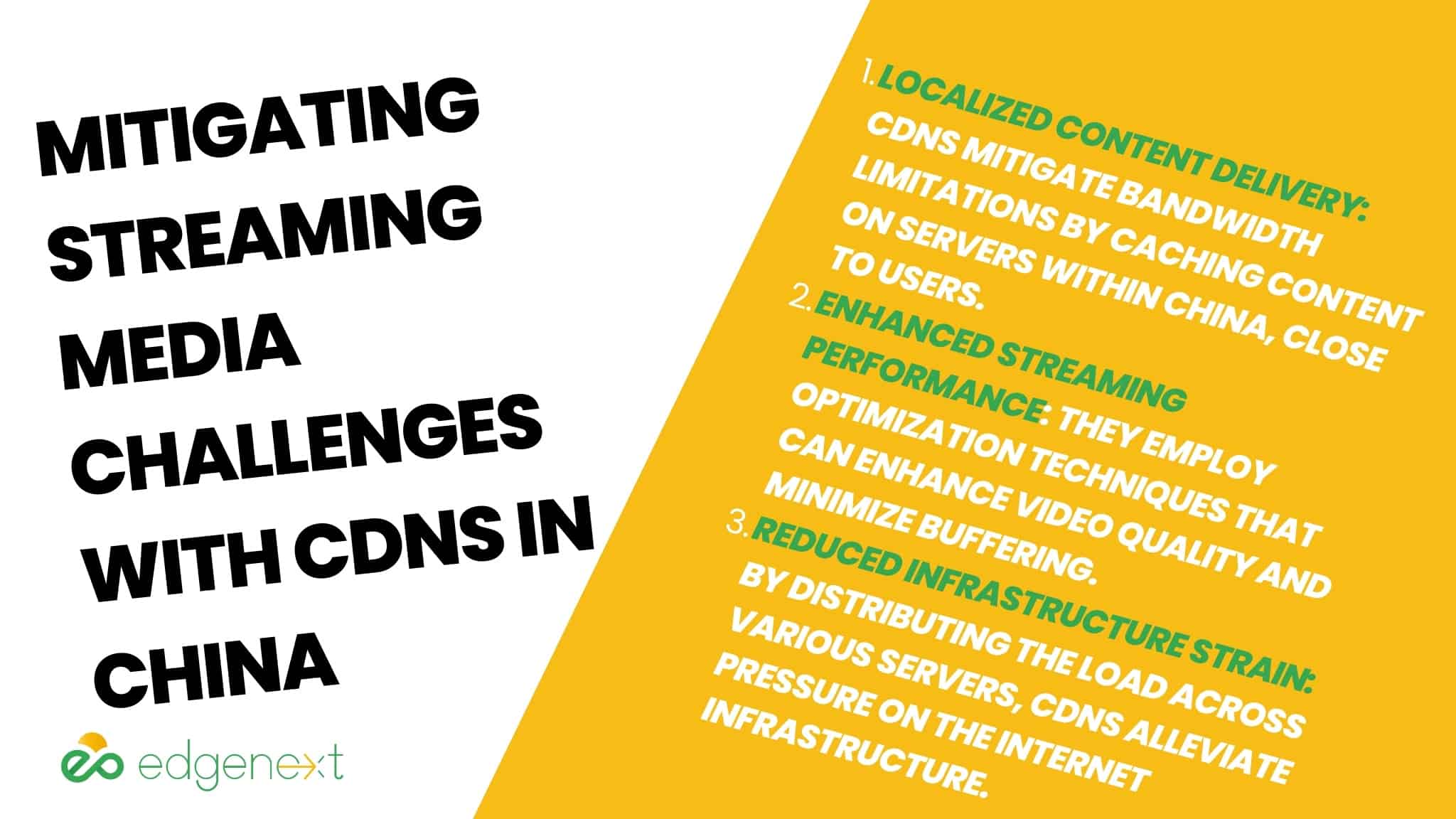
CDNs offer solutions to overcome bandwidth limitations by utilizing their network of servers in China. By caching and delivering content from nearby servers, CDNs can reduce the strain on internet infrastructure and provide faster streaming services for viewers. They also have advanced optimization techniques to improve video quality and reduce buffering.
Regarding regulatory compliance, CDNs are crucial in navigating China's strict censorship laws. This allows for a more seamless streaming experience for content providers and viewers.
VI. CDN Deployment Strategies for Optimal Streaming
Content providers should consider deploying CDN servers to ensure optimal streaming services in China. This allows for faster and more reliable delivery of content to Chinese viewers. Additionally, selecting a CDN provider with a strong presence in China and experience working within the country's unique landscape is crucial. They will better understand local regulations, infrastructure, and censorship laws, allowing for smoother navigation of these challenges.
Another important aspect to consider is the use of a multi-CDN strategy. By utilizing multiple CDN providers, content providers can effectively mitigate risks and ensure high-quality streaming services for their viewers. This approach allows redundancy in case one CDN experiences issues and optimizes delivery routes based on network conditions.
VII. Future of CDNs in China's Streaming Media
The future of China's CDN streaming media market looks promising as both industries continue to see significant advancements and growth. One emerging trend is edge computing, where CDN servers are strategically placed closer to viewers' devices, reducing latency and improving delivery speed. This technology has the potential to enhance the streaming experience for Chinese viewers greatly.
Another development is integrating artificial intelligence (AI) in CDNs, allowing for more efficient and intelligent content routing. This can help optimize delivery routes based on network conditions and provide real-time analysis to enhance streaming quality. Furthermore, with the rise of
5G technology, the potential for higher-quality video streaming will increase significantly. CDNs will play a crucial role in ensuring this content is delivered seamlessly to viewers in China, further solidifying their importance in the streaming media landscape.
VIII. Conclusion
In conclusion, CDNs are crucial in providing a high-quality streaming experience for viewers in China. With the unique challenges posed by network limitations and government regulations, CDNs are essential for content providers to enter and navigate the Chinese market successfully. Companies can overcome these challenges through strategic deployment and continuous technological advancements and deliver seamless streaming services to their audience.
Considering innovative CDN solutions is essential for content providers looking to enter the Chinese market or optimize their existing streaming services. At
Edgenext, we offer cutting-edge edge computing and AI-integrated CDNs explicitly designed for the Chinese market.
Contact us today to learn more about how our solutions can help you reach a wider audience and provide a superior streaming experience in China.
References:
· EdgeNext. Asia-Pacific 5G: Increasing Demand to Boost the Market Expansion. EdgeNext.
https://www.edgenext.com/asia-pacific-5g-increasing-demand-to-boost-the-market-expansion/
· IBM. Content Delivery Networks (CDN). IBM.
https://www.ibm.com/topics/content-delivery-networks
· EdgeNext. The Future of CDN Technology in China: Trends and Innovations. EdgeNext.
https://www.edgenext.com/the-future-of-cdn-technology-in-china-trends-and-innovations/
